
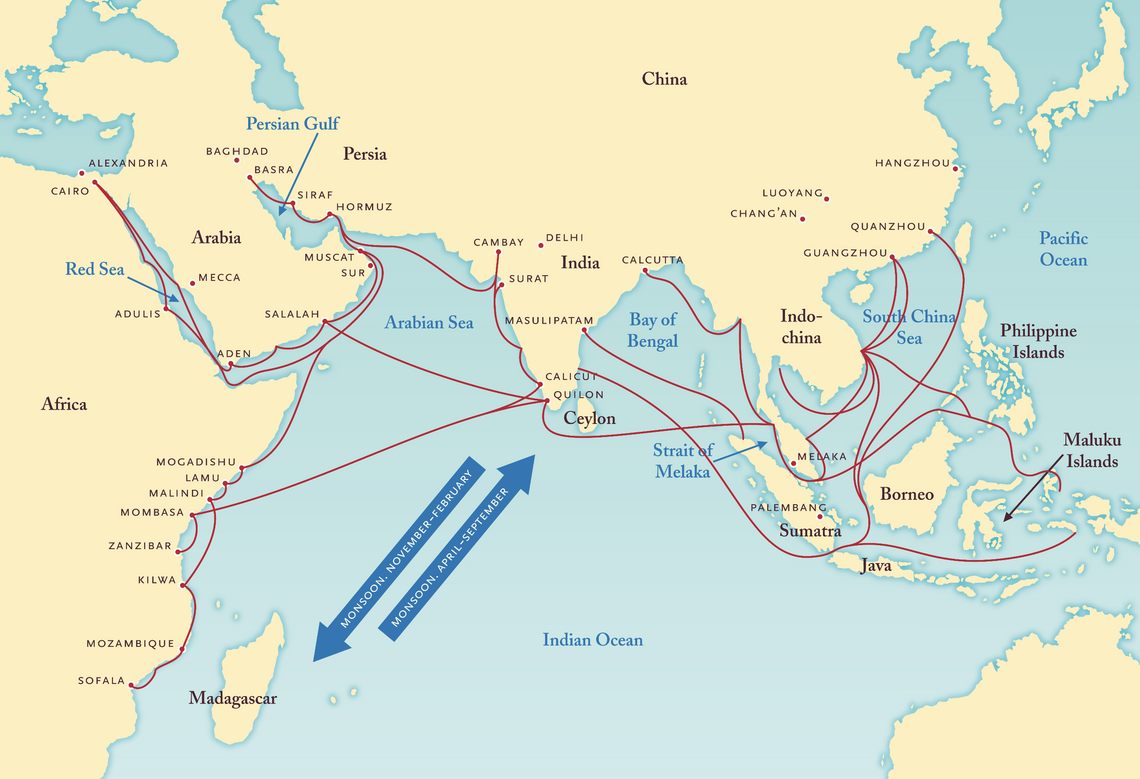
For centuries, the Indian Ocean was not a barrier — it was a bridge.
Across its waters sailed traders, scholars, and explorers who shaped the cultural and spiritual landscapes of entire regions. Among them were the early Arab Muslim merchants whose journeys would lay the foundation for what we now know as the Rawther community.
In the 7th century, during the time of Prophet Muhammad, Arab traders began establishing maritime trade routes that connected the Arabian Peninsula to the coasts of South India. The eastern shores of Tamil Nadu became one of their important destinations. But these traders did not remain outsiders. Many settled, married local Tamil women, and built families rooted in both Islamic faith and Tamil culture. From these unions emerged a distinct community — one that carried Arab spiritual heritage and Tamil cultural identity in equal strength.
“The Rawther story is not confined to one land — it is a legacy carried across oceans, strengthened by faith, shaped by culture, and sustained through generations.”
Over time, the Rawther identity evolved. Community traditions speak of connections with Turkish cavalry associated with the Ottoman Empire. These influences strengthened the community’s association with equestrian skill, discipline, and martial pride. Whether through trade or tradition, the Rawther name came to represent resilience, adaptability, and honor.
Yet the story does not stop in South India.
By the 18th century, Rawther merchants were active participants in Indian Ocean commerce, extending their trade networks to the Malay Peninsula. Strong commercial ties were built with the Kedah Sultanate, where goods such as textiles, rice, spices, and horses were exchanged. These relationships endured through shifting political landscapes, including colonial rule, and continued until Malaya achieved independence in 1957.
What makes the Rawther legacy remarkable is not just its age — but its continuity. Across centuries of migration, trade, marriage, and political change, the community preserved its identity. Faith remained central. Family bonds remained strong. Enterprise remained a defining characteristic.
The Rawther story is ultimately a story of connection — between Arabia and Tamil Nadu, between India and Southeast Asia, between past and present. It reminds us that identity is not static. It is carried across oceans, strengthened through unity, and passed down through generations.
Today, the Rawther legacy stands as a testament to cultural fusion, endurance, and the power of shared history.